
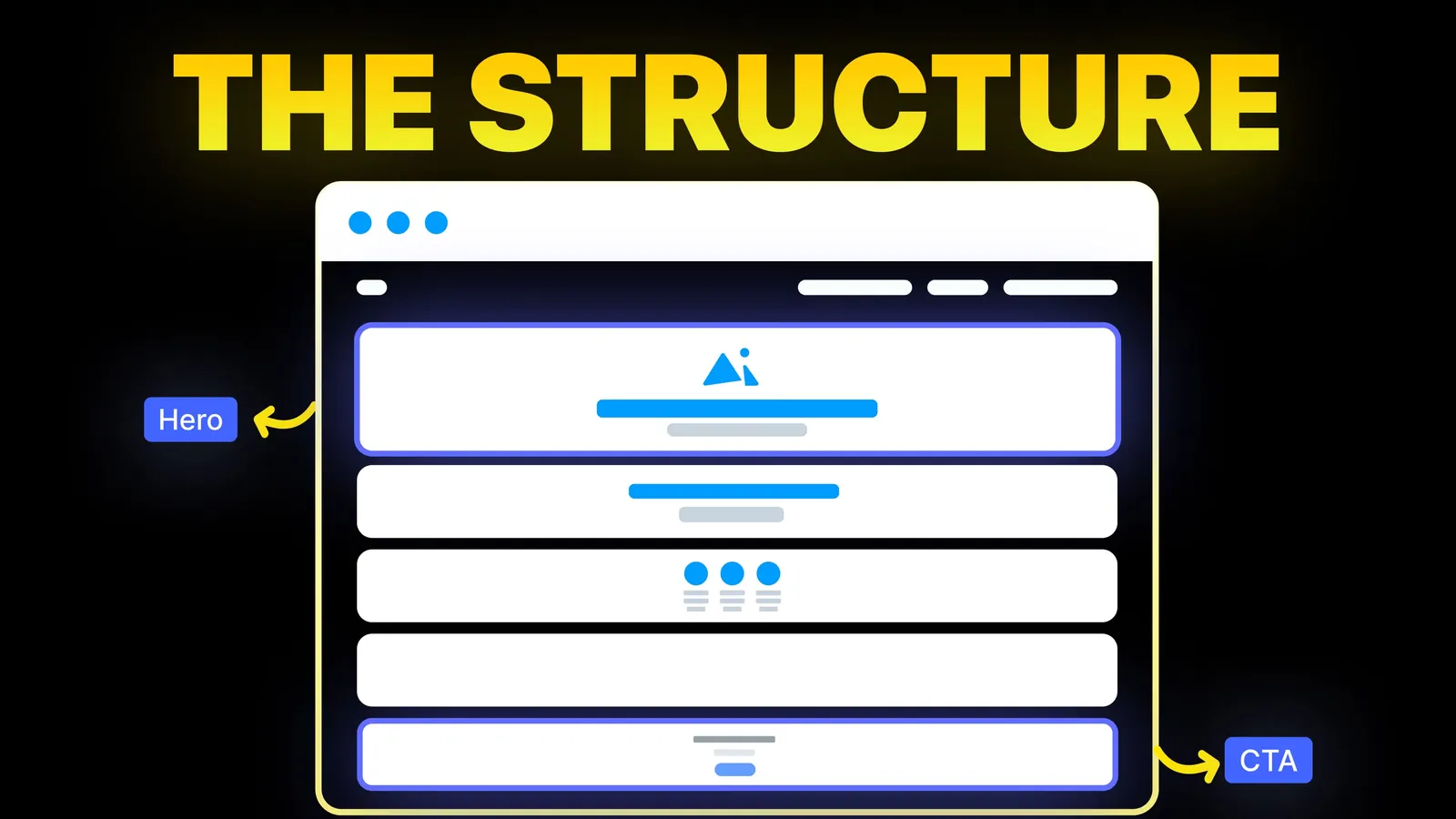
How to Turn Your Website Into a High-Converting Sales Tool
The structure behind a website that sells: the five decisions that carry conversion, the homepage section order, and how to rebuild without losing traffic.
Web Design
Search for portfolio page design and you get Dribbble boards, Awwwards galleries and template lists. Further down, a few articles say what clients look for. They are written for a single designer selling themselves, and they disagree on basics like how many projects to show. This guide reads them side by side and turns them into a page spec for a studio or service business.
A portfolio page for a studio or service business is a short, curated set of project cards, each opening into a page that tells the problem, the work and the result. Lead with the work most like the work you want to win. Give each card a title, the client type, the service you did and one line of result. Let visitors filter only if you have enough projects to need it. Put a call to action on the portfolio page and on every project page, and keep the page fast and usable on a phone.
About us: Amariq is a web studio and has a portfolio of its own. This guide is general advice, not a description of our page.
We searched Google (US, English) for "portfolio page design" on 24 November 2026, and again for "what clients look for in a portfolio page website". The first search returned galleries (Dribbble, Awwwards, One Page Love, Killer Portfolio, Wall of Portfolios, Framer's gallery) and template pages (Figma, Webflow). The second returned advice articles from Dribbble, Webflow (24 October 2025), Format, a web agency (Altus), Trevatt Design (14 April 2026), Wix and others. We read the Format and Trevatt Design articles in full and saw the rest as snippets.
Both articles we read speak to an individual creative: a photographer, designer or artist. Format's piece is a checklist for creatives, and Trevatt's is from a London agency founder talking to designers. A studio or a trades business has different questions: should the page show client names, can we filter by service, how do we handle work we are not allowed to show. This guide answers those, and marks which parts come from the sources and which are our own judgement.
Format describes how a client reviews a portfolio as a sequence: in the first three seconds, whether it looks professional, loads quickly and says what the person does; then whether the work is relevant and good enough; then whether there is evidence of thinking and not just polish; finally, whether they can contact the person easily and whether others trust them. This is Format's own model, not a measured study, but it is a useful order to design in:
| Stage | The visitor's question | What the page should give |
|---|---|---|
| First moments | What is this, and is it quick? | A one line statement of what you do and for whom, a fast load |
| Next | Is the work relevant to me? | Cards labelled by client type and service, best-fit work first |
| Then | Can you think, not just design? | The problem, your approach and the result on each project |
| Last | Can I trust you and reach you? | Proof from others, a visible way to get in touch |
Trevatt adds the point that the page should speak to the client and not the designer: talk about outcomes, not tools. Your client does not care about your grid system or Figma workflow.
| Question | Format | Trevatt Design |
|---|---|---|
| How many projects? | 8 to 12 | "Five strong projects beat twenty average ones"; if you only have two or three, show those |
| How long should a description be? | Three to five sentences for most projects | Even two or three sentences of context make a significant difference |
| How often to update? | Every three to six months (FAQ); at least every quarter (mistakes list) | At least twice a year |
| Navigation | Work, About, Contact; two clicks to contact | Projects, About, Contact; let people scroll rather than click through slideshows |
| Speed | Compress images, avoid heavy animation | Aim for a Largest Contentful Paint under 2.5 seconds, avoid a 4 MB autoplay hero video |
The differences are small, and the common ground is the useful part. Our reading: five to twelve is a range, not a rule. Show every project that is good and relevant to the work you want next, and stop there.
One line stating what you do and for whom, such as "Websites for dental practices" or "Kitchen fitters in Leeds". Format's example makes the same point: "Brand identity designer for food and hospitality companies" tells the client everything in a line, where "I create beautiful experiences" tells them nothing. Under it, the grid.
Each card should hold:
The first three are our spec; the fourth follows Format's advice to include a measurable outcome where possible.
Both sources give the same three questions, which we use as headings:
| Heading | What goes under it |
|---|---|
| The problem | One or two sentences about what the client needed or what was wrong |
| What we did | The approach, in a few sentences, with a few images that show it |
| What happened | The result, with a number only if you can stand behind it |
Then a testimonial from that client if you have one (our testimonials page guide covers how to ask and how to show it), and a call to action. Trevatt suggests a line such as "Like what you see? Let's talk." on every case study. Put the contact path in the same place on every project page.
| Number of projects | Filters? |
|---|---|
| Up to about eight | No, a simple grid is enough |
| Nine to twenty | Optional filter by service or industry, if you serve distinct buyers |
| More than twenty | Reconsider; both sources recommend curation, and Format suggests a separate archive area for the rest |
The thresholds are our judgement. The principle is Format's: if you have 40 projects listed, you are asking the client to do the editing for you.
Not every job can be shown by name. Your options, from best to worst:
What you must not do is present invented clients, invented results or a mock-up as client work. Buyers check, and a fake case study loses the real ones.
For a studio or service business we would design the portfolio page and a project page template together, so adding a new project is a matter of filling in the three headings. The price comes from scope and is never hourly, paid in three steps: a 40% start payment, 30% when the design is approved and 30% before launch. Ownership is simple: after the final payment you hold the design, the copy and the code, and the domain, hosting and analytics logins are in your own name from the start. Details are on the web design service page, or book a call to talk it through.
A one line statement of what you do, a grid of curated project cards, a page for each project with the problem, your work and the result, proof from clients, and a visible way to get in touch.
The sources we read disagree: Format says eight to twelve and Trevatt Design says five strong projects beat twenty average ones. Show every good, relevant project and no more.
Only with permission. If you cannot, label the work by client type and say so. Do not invent a name.
Format suggests three to five sentences for most projects. Trevatt says even two or three sentences of context help. Lead with the problem and end with the result.
Trevatt says at least twice a year and Format says every three to six months. Add new work soon after a project ends and remove work that no longer reflects your standard.
Format says yes: social platforms are discovery tools, and a portfolio site is where the serious evaluation happens.
The portfolio page is the collection and the case study is one project told in full. Use the portfolio to browse and the case studies to decide.

The structure behind a website that sells: the five decisions that carry conversion, the homepage section order, and how to rebuild without losing traffic.
A website migration checklist sorted by your kind of move: hosting only, URL changes or a new domain, built on Google's site move pages. Checked 25 Nov 2026.
Thank you page design for a business site: what to confirm first, one next step, and the build rules behind it. Checked 13 Nov 2026.