
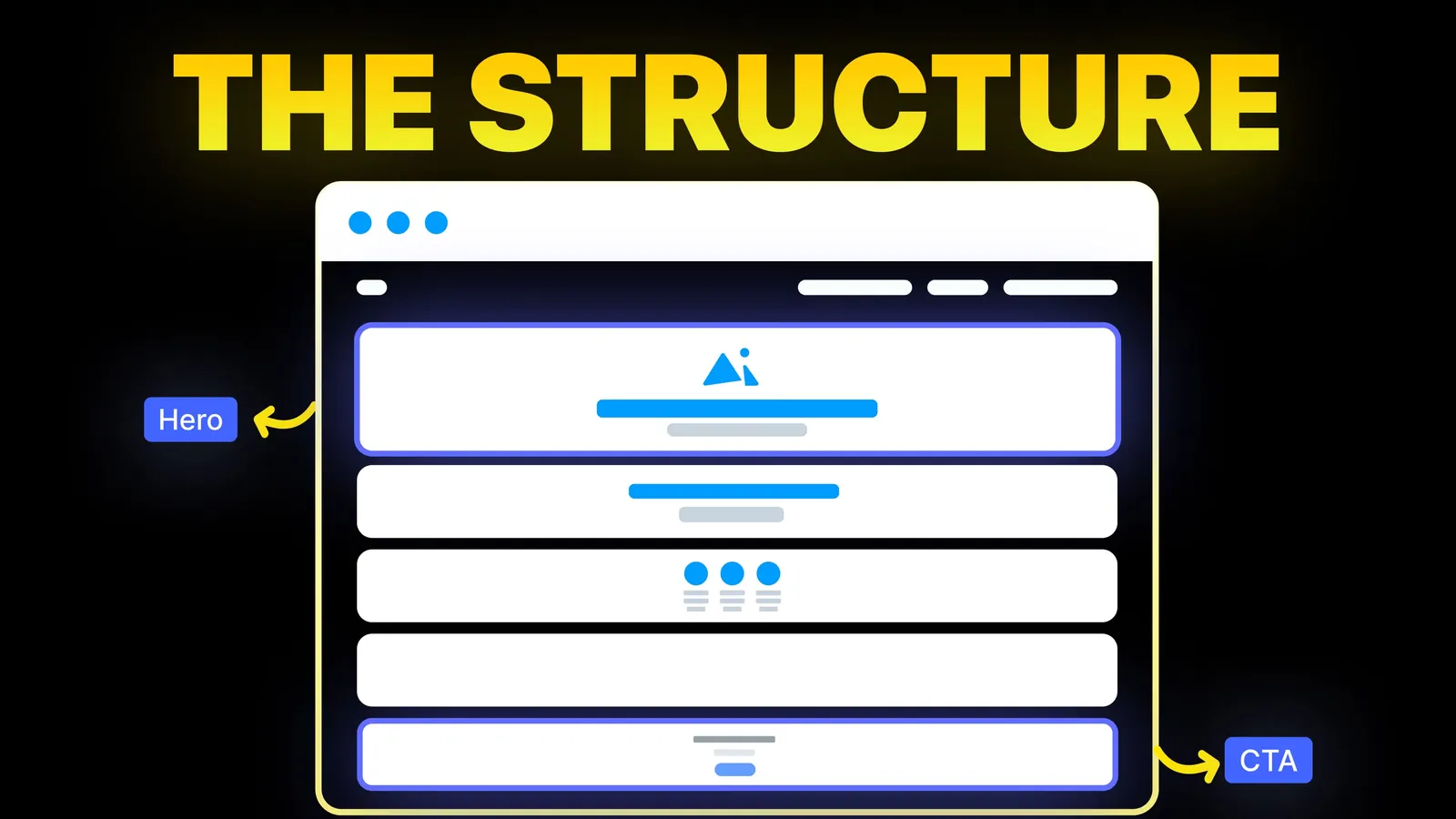
How to Turn Your Website Into a High-Converting Sales Machine
The structure behind a website that sells: the five decisions that carry conversion, the homepage section order, and how to rebuild without losing traffic.
Web Design
llms.txt is a short Markdown file that points AI agents to a site's most useful pages. Google says its search ignores the file, and one large study found most files never get read. So why publish one? We read the current v2 proposal, Google's own wording and the data on 2 November 2026, then looked at our own file.
llms.txt is a plain text file in Markdown, usually at yoursite.com/llms.txt. It gives AI agents a short summary of your site and a curated list of links. It is not a ranking factor, and no major AI company we read has said its crawlers rely on it. If you run developer docs, publish one. If you run a service business and your site basics are in good order, it is a cheap and harmless experiment. If your pages are not indexed yet, fix that first.
An agent reading a web page has to dig through navigation, scripts and layout to reach the text. Howard's proposal argues that agents do better with concise information gathered in one place, because they can only hold so much at once. The file offers that place, and detail sits behind its links.
It is often called "robots.txt for AI", and that is misleading. These three files do different jobs:
| File | Job | Who it speaks to |
|---|---|---|
robots.txt | Says what automated tools may access | Crawlers |
sitemap.xml | Lists all the pages you want found | Search engines |
llms.txt | A short, chosen guide to what matters | Agents, when they need it for a task |
So llms.txt cannot block anything. If you want to control AI crawlers, that is a robots.txt job. The proposal also expects the file to be used on demand while an agent helps someone, more than for model training.
Most guides on page one still describe the first version. Howard's changes page sets out the differences, and they matter if you plan to do this properly.
| Topic | Version 1 | Version 2 |
|---|---|---|
| Location | Subpaths allowed, with scope undefined | A file covers everything under its path, and the most specific file wins |
| Markdown pages | Add .md to the full URL | Also allows replacing the extension, as in page.md |
| Discovery | Not defined | Link relations, in HTML or an HTTP header |
| How agents use it | A tool to expand it into context | Agents view or search the file, then follow links |
| "Optional" section | Told the tool what to leave out | A convention for secondary links |
The discovery part is the new idea. A page can point to its Markdown copy with rel="alternate" type="text/markdown", and to the covering file with rel="describedby". A small business does not need this. A docs team may well want it.
The order is fixed: an H1 name, a blockquote summary, optional notes with no headings, then H2 sections holding link lists. Only the H1 is required. A section called "Optional" holds links an agent can skip when it needs less.
Here is a template for a service business. It is an illustration, so swap in your own details.
``` # Example Plumbing Co
Licensed plumber serving Denver. Emergency callouts, repairs and bathroom fitting for homes and small businesses.
Call for emergencies. Quote requests are answered within one working day.
```
The proposal gives a few rules for writing it: use clear language, add a brief note to each link, avoid unexplained jargon, and test the file by asking an agent questions with only that file to go on. It says links should point to LLM-friendly content, such as Markdown versions of pages. Plain web pages still work as links, though an agent then has to deal with the HTML.
We publish our own llms.txt at the site root. It is about 6 KB with 39 links. The sections are Main pages, Services, How projects work, Guides on the October 2026 PHP security flaws, Guides on cost and platform choices, Free tools, and All posts.
Here is the start of it, cut for space:
``` # Amariq
Amariq is a design and development studio that redesigns underperforming websites for marketing teams and ecommerce brands, building on Webflow, WordPress, Shopify and Framer. Projects are priced from scope, never by the hour.
```
Two choices are worth copying. We put facts that people often ask about in the file itself, such as how projects are paid for, so an agent need not hunt for them. And we group posts by topic and do not paste the whole sitemap. We make no claim that the file has earned us anything, since that would be hard to prove, and the evidence below gives no reason to expect it.
These are the figures from people who have measured it. Each measures something slightly different, so read the limits.
| Source | Finding | Limit to keep in mind |
|---|---|---|
| Ahrefs, May 2026 study of 137,210 domains | 28% had a file (about 38,000). 97% of those got no requests that month. Bots made 96% of requests to the files that were read | Its customers lean technical, so Ahrefs calls 28% an upper bound |
| Ahrefs, same study | Named AI tools made 19.5% of those fetches, led by GPTBot and then Claude-Code. About 12% came from checkers and researchers | Ahrefs calls these figures a ceiling on real use |
| Semrush, on Search Engine Land | No link found between the file and better AI results. Logs from mid-August to late October 2025 showed no visits from Google-Extended, GPTBot, PerplexityBot or ClaudeBot | One site, in 2025 |
| Semrush, citing NerdyData | 951 domains had one in July 2025, and 16,670 by September 2026 | A different count from Ahrefs' sample |
The picture is fairly clear. Adoption is growing quickly and use is low, but not zero. Fetches come largely from bots, and the file sees real use mostly in coding tools.
Google has two messages, because different teams have different jobs.
Google Search says no. Its AI optimization guide, last updated 10 July 2026, says you do not need new machine readable files, AI text files, markup or Markdown to appear in Search, as Search does not use them. It adds that it is "completely fine" to keep llms.txt files for other services that use them. Google's AI features page says the same about AI Overviews and AI Mode.
Chrome's Lighthouse has a check. It sits under Agentic browsing audits, and the page was last updated on 5 May 2026. A server error when fetching the file fails the audit. A 404 is marked not applicable, because the file is optional. So this audit does not mean Google wants one from you, and an empty result is nothing to fix. A tool that warns you about a missing llms.txt is going further than Chrome does.
So an SEO seller who says llms.txt lifts rankings is contradicting Google's own page. Ask for their proof.
| Your site | Our view | Why |
|---|---|---|
| Developer docs or an API | Yes, and add Markdown pages | This is the main use the proposal names, and coding agents follow these links |
| Software product with help docs | Yes, for the docs | Agents may answer questions on your product from these pages |
| Agency or service business | Optional, after the basics | Costs little, with no known ranking benefit |
| Local trade or small shop | Low priority | Your Google Business Profile, reviews and local pages will do more |
| Large store | Optional | Keep it to policies and top categories. Do not list every product |
| A site not yet in Google | Not yet | Sort out why it is not showing on Google first |
Better work usually comes first: clear pages, plain answers, real facts and pages that load. Agents and search systems read those too. Our website audit checklist is a good place to start.
llms.txt and upload it to your site root, then open the address in a browser to see it load as plain text.Do not put in anything you would not want published. It is a public file.
You may not need to write it at all. The proposal lists the first four rows below, and Ahrefs lists its own tool on its site. These are the makers' descriptions:
| Platform or tool | What it does |
|---|---|
| Wix | Listed as generating a file for every Wix site |
| Yoast SEO (WordPress) | Listed as generating and maintaining a file |
| AIOSEO (WordPress) | Listed as having a generator |
| Mintlify, GitBook | Docs platforms that serve a file |
| Ahrefs free generator | A free web tool for a first draft |
On Framer, its docs say you add the file yourself. On a static site you just upload it. Whichever you use, read what a generator produces, because a list of every URL is not the curated guide the format is meant to be. A generator can draft the structure, but only you know which ten pages matter most. There is no reason to pay for this.
We build sites on Webflow, WordPress, Shopify and Framer, and on any new build we can add an accurate llms.txt with little fuss. The bigger job is making the pages themselves clear enough to quote, with structure and copy that answer real questions. See our services to find out how we work.
It is a short Markdown file on your site that tells AI agents what your site is and which pages matter most. Think of it as a guide, not a rule, since it does not block or allow anything.
Not in Google. Its guide says the files will neither harm nor help visibility in Search, as Search ignores them. We found no proof from other studies of a boost in AI answers either.
Ahrefs recorded fetches from GPTBot and Claude-Code on the small share of files that got traffic. A fetch is not proof of use, and the pages we read found no AI company stating its crawlers rely on it.
robots.txt says what crawlers may access. llms.txt offers a short guide to useful content. One sets access, the other suggests where to look, so llms.txt cannot replace robots.txt.
Usually at the root, as yoursite.com/llms.txt. Version 2 also allows subpaths, such as /docs/llms.txt, which covers just the pages beneath it. The most specific file applies.
Yes. Ahrefs has a free one, Yoast and AIOSEO offer it in WordPress, and Wix is listed as generating one by itself. You can also write it by hand in any text editor in under an hour.
It is a name you will see for a single file holding a site's full documentation, and some docs tools produce one. The main v2 proposal text we read does not define it, so treat it as a tool convention.
Google says it will not harm your visibility in Search. The real risks are out-of-date facts and private details in a public file, so keep it accurate and short.

The structure behind a website that sells: the five decisions that carry conversion, the homepage section order, and how to rebuild without losing traffic.
Local SEO for small business from Google's own pages: ranking factors, a Business Profile checklist, review rules and website pages. Checked 1 November 2026.
Five website color schemes with every text and button pair scored for contrast against WCAG 2.2, plus fixes for the pairs that fail. Checked 1 November 2026.