

Case study
A Facebook phone cover shop, turned into a store people can browse
UV Gadget Baba prints custom phone covers in Bangladesh and sells them with cash on delivery. We designed its online shop from the shop's own catalogue: 639 designs in 14 categories, a product page for every design, and a page where customers put their own photo on a cover for their exact phone.
In short
- Who it is
- UV Gadget Baba, a Bangladeshi shop that prints phone covers on a UV flatbed printer, for 100+ phone models, and delivers anywhere in the country with cash on delivery.
- Who shops there
- Young buyers who want a gaming, anime, football or Bangla typography cover, or their own photo, and who order from their phone.
- The hard part
- The catalogue lived as hundreds of photos on the shop's Facebook page. Each design had only a code printed in the corner, and every order started with a chat.
- The idea
- Turn those photos into a real catalogue: every design gets a name, a category and its own page, and choosing the phone, the case and the quantity happens on the page instead of in a chat.
- The design
- A light, cool storefront where the covers carry the colour, shelves like the shops Bangladeshi buyers already know, and one orange for every buy button.
- Good to know
- The prices, delivery times and phone model list in the screens are working figures for the design stage, confirmed with the shop before launch.
The client
UV Gadget Baba is a print shop in Bangladesh that makes custom phone covers. Customers pick a ready design or send their own photo, the team prints it on a UV flatbed printer, checks it by hand and packs it, and the cover goes out by courier with cash on delivery anywhere in the country.
The shop sells through Facebook, TikTok and WhatsApp. Its range is wide: gaming and anime art, Bangla and Arabic lettering, football fan covers, cute and Hello Kitty prints, bows, cars, carbon patterns and clear case prints, for iPhone, Samsung, Xiaomi, Realme, Oppo, Vivo and more.
Where it started
Every design was a photo post on the shop's Facebook page, with a code printed in the top corner. To buy, a customer scrolled the page, took a screenshot, sent it in a chat with their phone model and waited for a reply. It works for regular customers, but it is slow for someone new, and nobody can browse 600 designs in a feed.
The brief came from a long meeting with the shop: a real online store, easy on a phone, built around their own products, with cash on delivery and a way to order a cover with your own photo.
A catalogue built from the shop's own photos
We worked through 865 photos from the shop's Facebook page. The code on each poster was read by text recognition, and the series in each code decides its category. Reposts of the same design were removed, and process shots, banners and chat screenshots were left out of the shop.
The result is 639 designs in 13 categories, plus Your own photo, with real orders from the shop's posts as examples. Every design keeps the shop's own code, so an order on the site still matches the code the team prints from.
A home page that works like a shop window
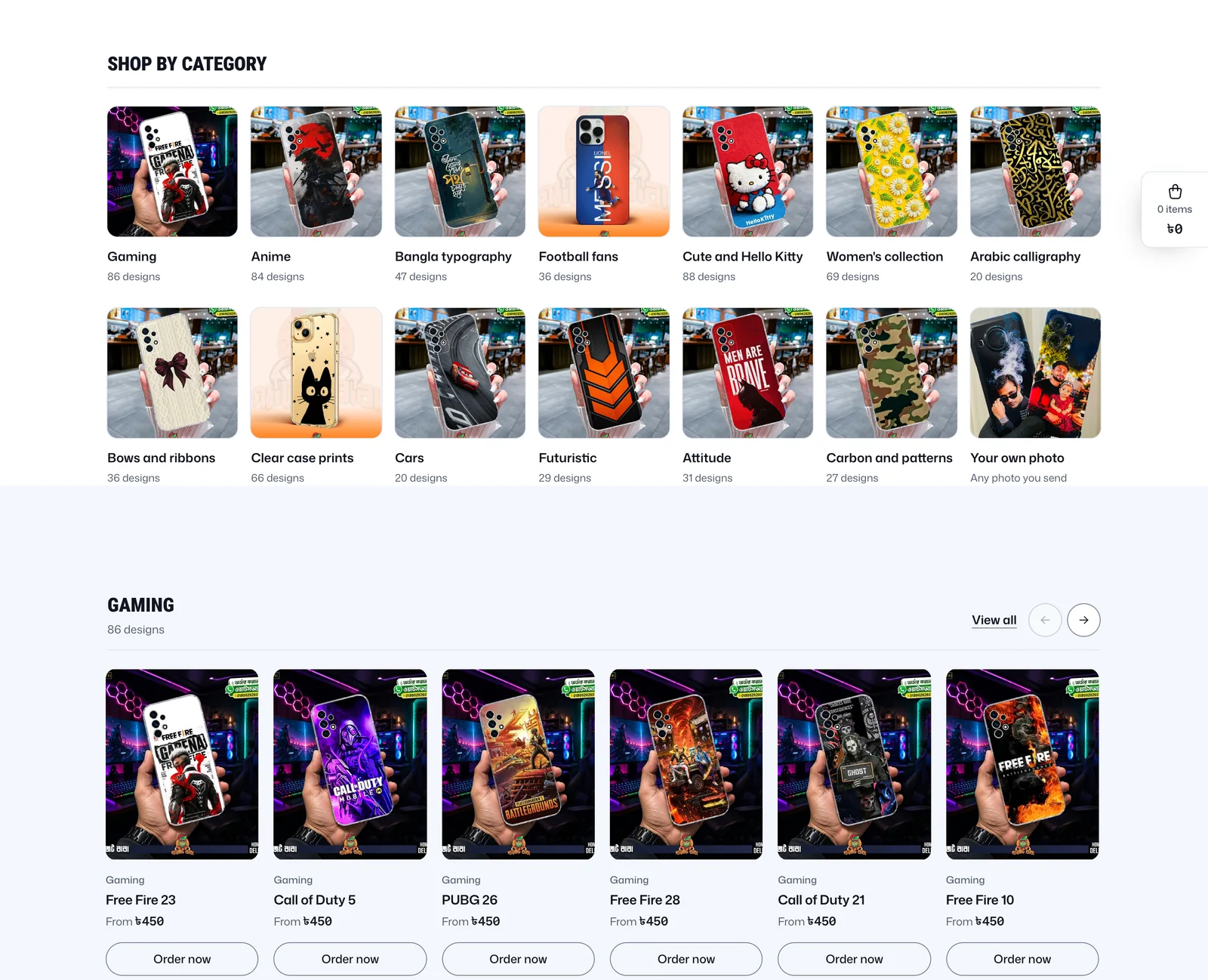
The first screen is short, the way an e-commerce hero should be: a plain headline, two actions, three facts from the shop's own banner, and a fan of five real covers cut out from the shop's mockup photos. Each cover in the fan opens its own product.
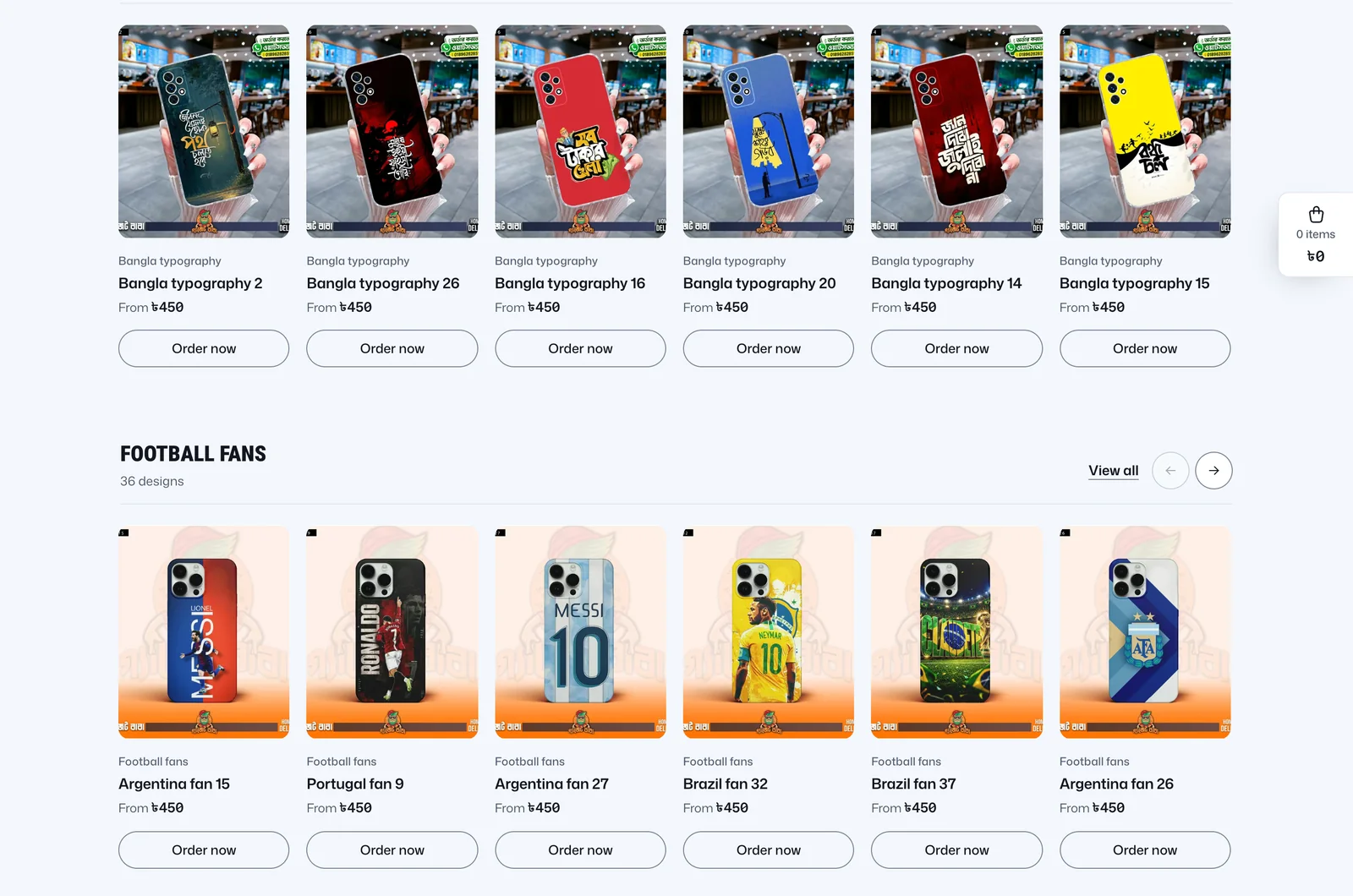
Below it, the layout follows the big Bangladeshi gadget shops, because that is how local buyers already shop: the categories as tiles, then one horizontal shelf per category, with View all and arrows to slide through more designs. Football fans was moved up to fourth place, where the fans will see it early.
Search that answers while you type
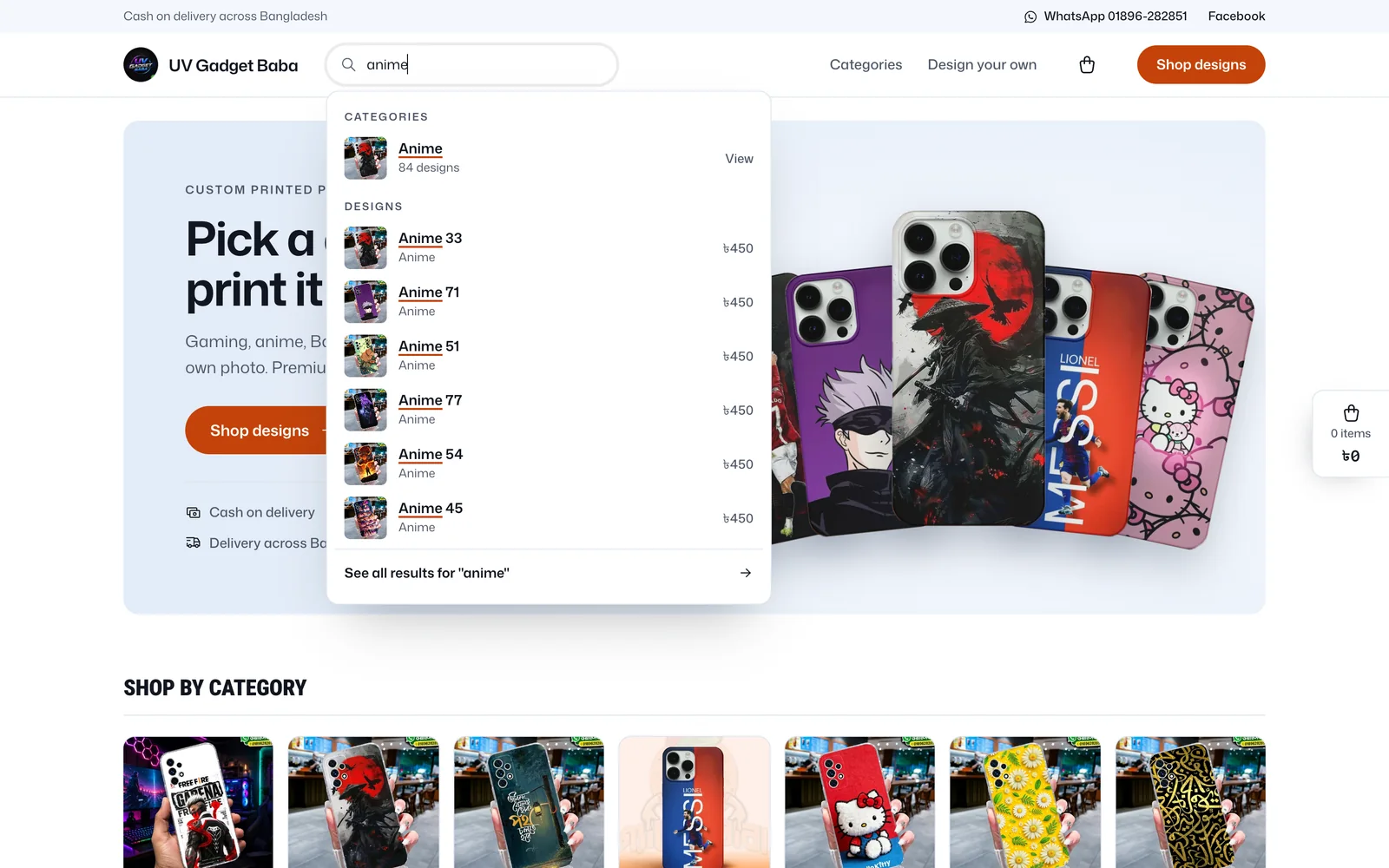
The search sits in the header on every page. As soon as a customer types, a list opens under the field with the matching categories and designs, each with its photo and price. See all results opens a full page.
A product page for every design
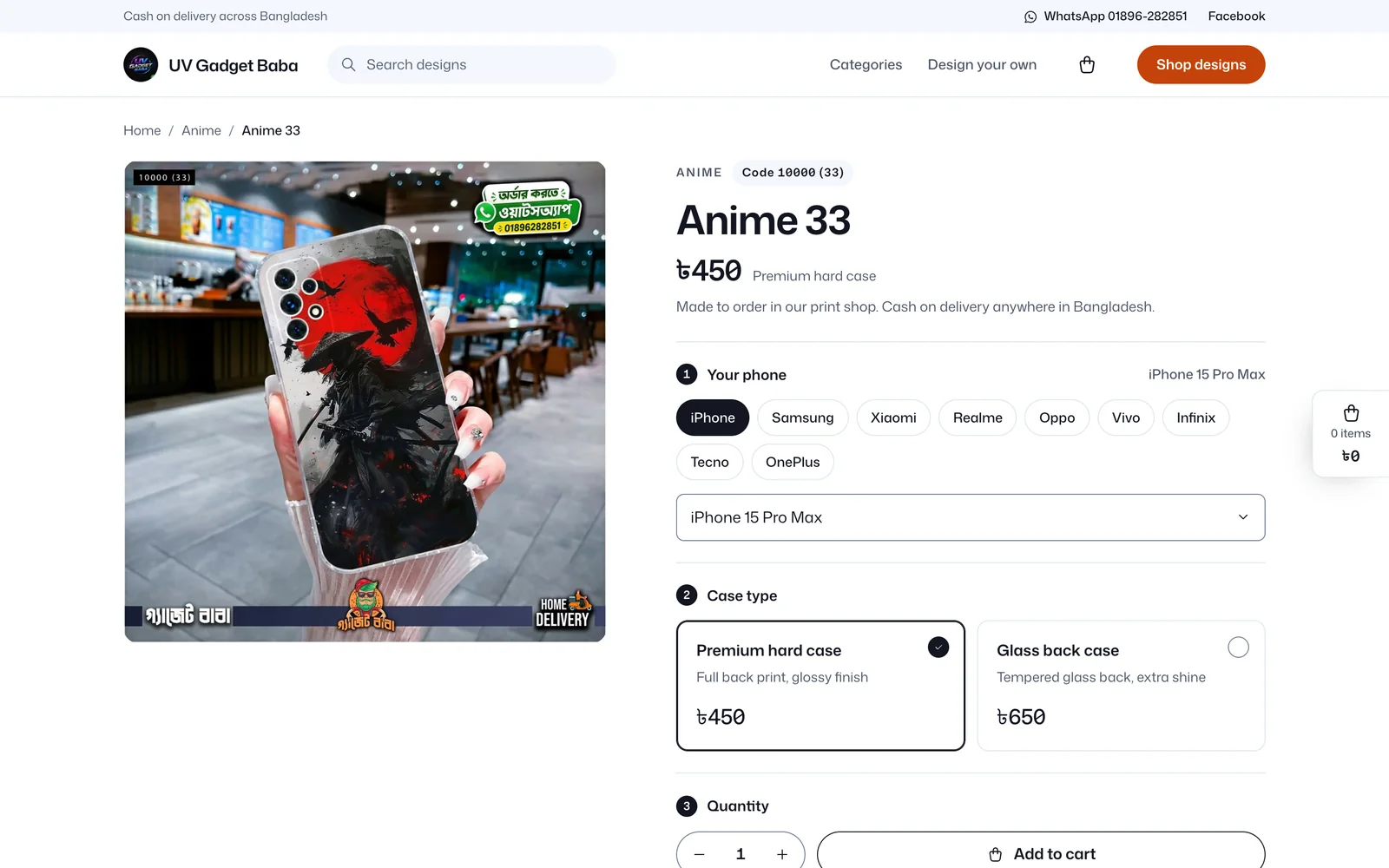
Each of the 639 designs has its own page and address. The poster sits large on the left. On the right, the category, the shop's code, the name and price, then three numbered steps: your phone, the case type and the quantity, with Add to cart and Order now. The phone and case type are remembered while the customer browses, so the second cover takes seconds.
For those who still prefer a chat, a WhatsApp link opens with the design already written in. Under the buttons, four short points answer the usual doubts: how payment works, delivery, the check before printing and where the cover is printed.
Design your own, on your exact phone
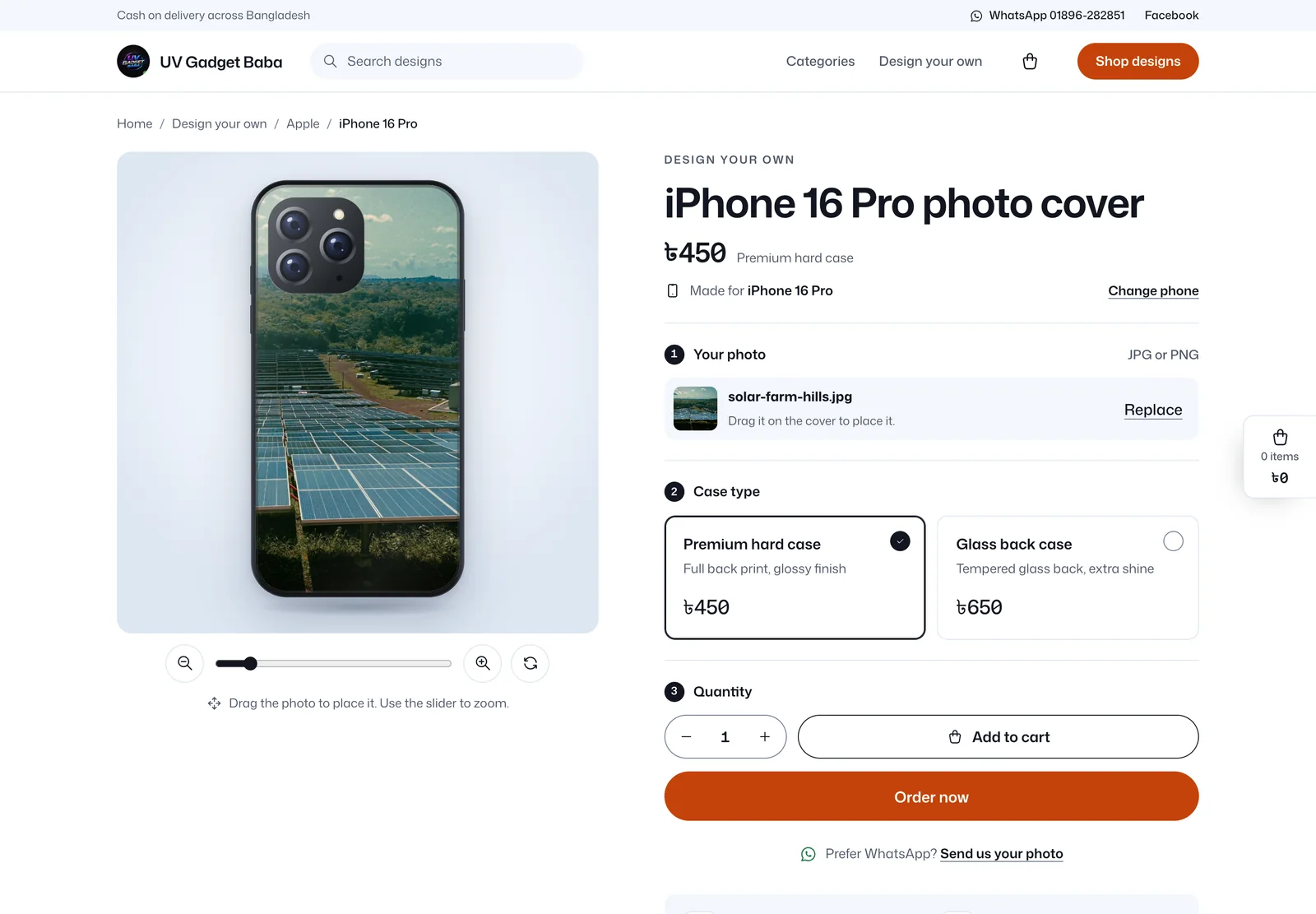
The shop's page is full of covers made from customers' own photos, so this order gets a page of its own. Step one is the brand, shown as tiles with each brand's typical camera layout. Choosing a brand opens its models on the same page, grouped by series, with a model search for anyone in a hurry.
The model opens a live preview of the cover. The customer selects a photo, drags it into place and zooms it, and sees it on a drawn case with the camera bump, rim and gloss in place. The finished cover then appears in the cart and at checkout exactly as it will be printed, which saves a round of messages before every order.
Cart and checkout for cash on delivery
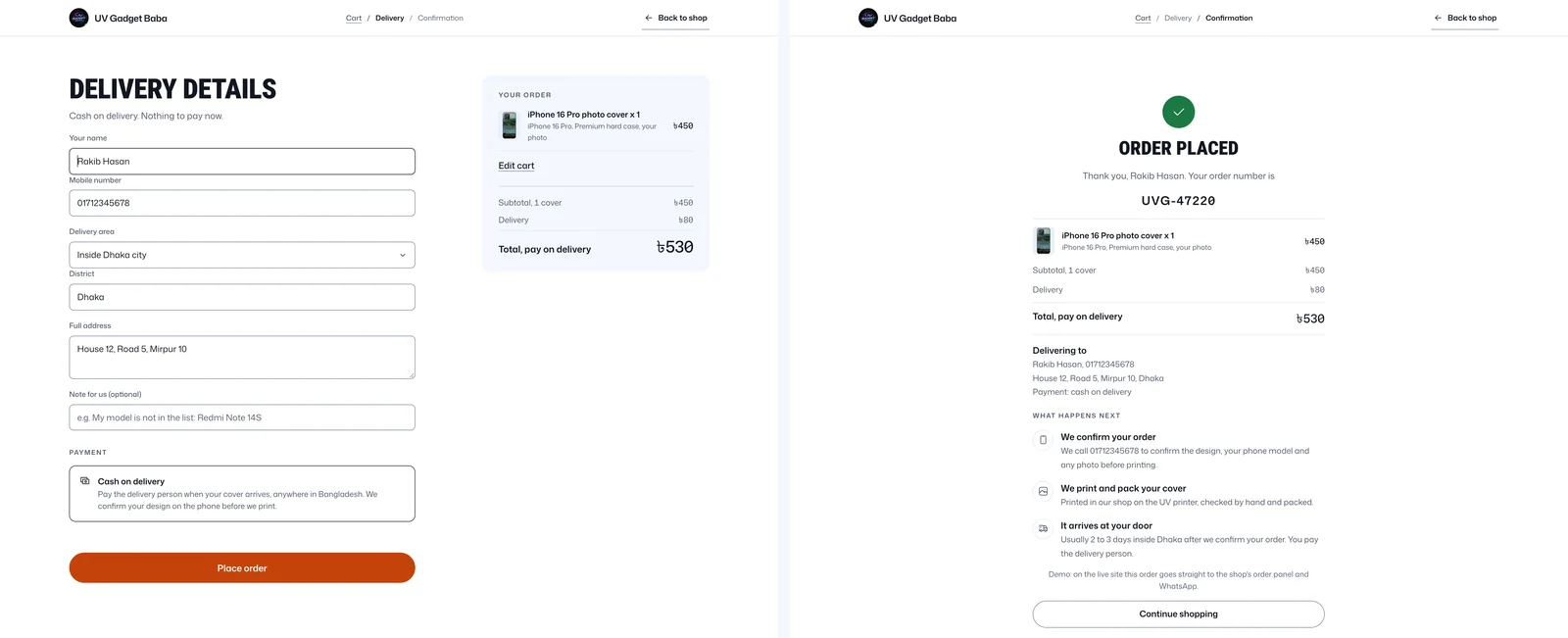
The cart opens as a drawer, so the customer never loses their place. Checkout is its own calm screen with a simple trail, Cart, Delivery and Confirmation: name, mobile number, delivery area, district and address on the left, the order with each cover's picture on the right, and cash on delivery as the payment. The delivery charge follows the area chosen.
The confirmation repeats the order and lists the next steps, from checking the design to the cover arriving at the door.
The shop's own photos, not stock
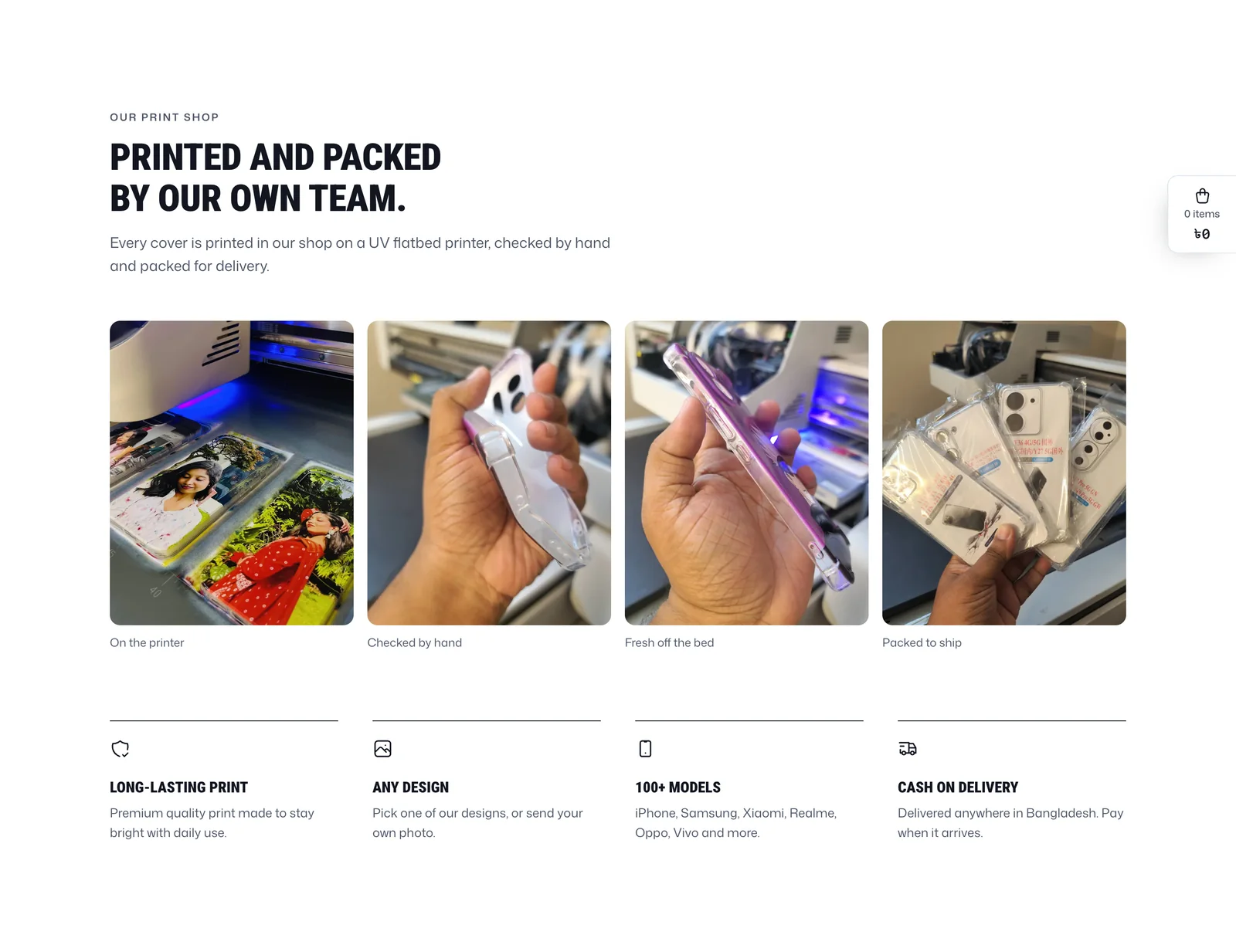
There is no stock photography anywhere on the site. The covers are the shop's own product photos, and a print shop section shows the real process: covers on the UV printer, checked by hand, fresh off the bed and packed to ship. For a shop that sells online with cash on delivery, showing the real workshop builds more trust than any slogan.
The design system
The covers are loud and colourful, so everything around them is quiet. The grounds are a pale, cool blue-grey, the text a deep ink, and one burnt orange is kept for the actions that sell: Shop designs, Order now, Add to cart and Checkout. Selected options turn ink, so the orange never competes with a choice.
Mona Sans carries the text and the controls, and Roboto Condensed in heavy capitals sets the section titles, like the labels on a shop shelf. Icons come from one outline set. Muted text passes 6:1 contrast on every ground, and white on the orange button passes 5:1.
Fast with 1,300 images
An image shop lives or dies on loading speed. Every design image, about 1,300 of them across cards and product pages, is compressed to AVIF. Measured against the originals, they look sharper than the WebP files they replaced while being 15 to 28 percent smaller. The first view of the home page weighs 1.47 MB on a computer and 1.06 MB on a phone, and images below the screen load only as the customer reaches them.
Made for the phone first
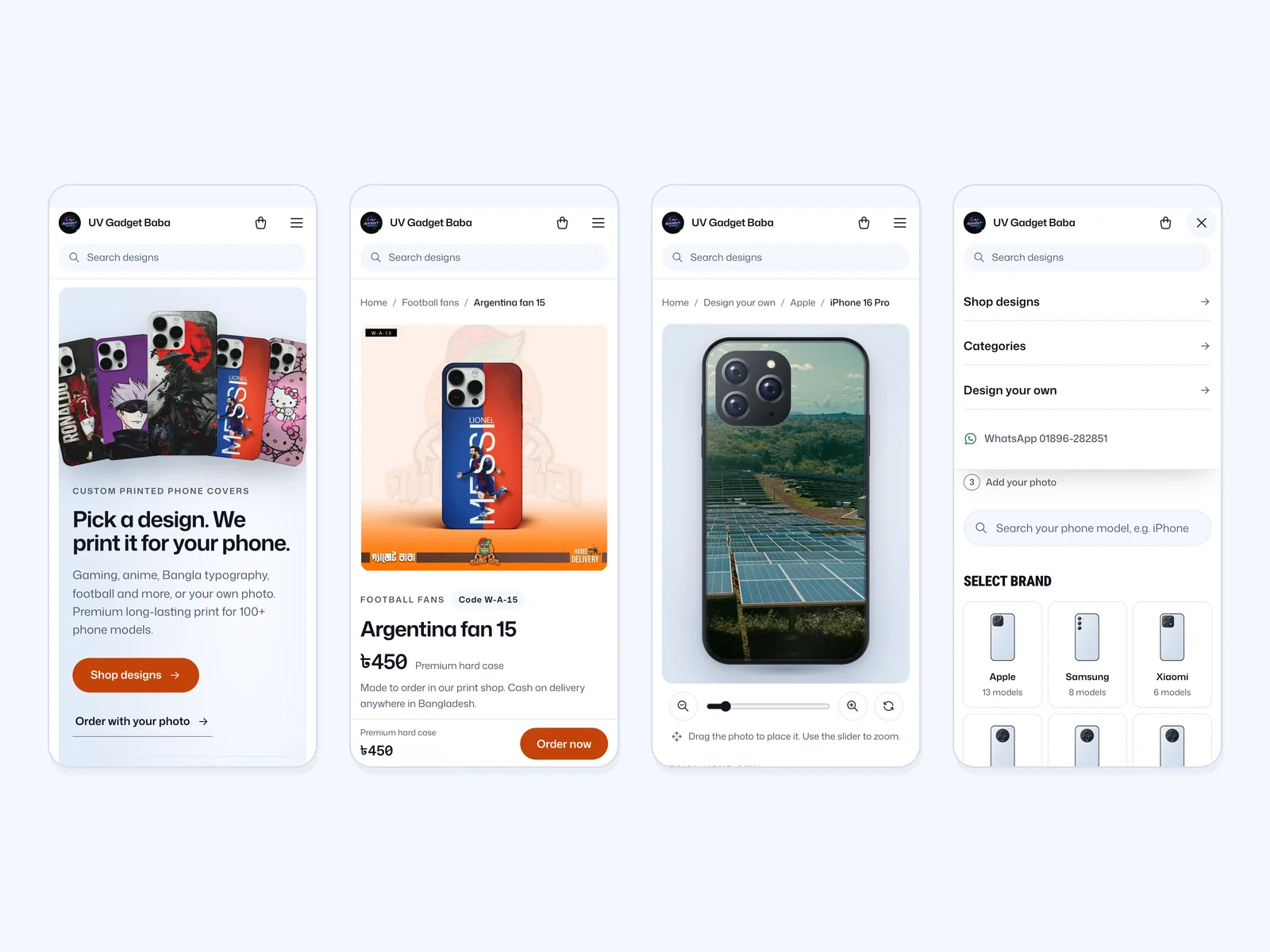
Links to the shop are shared on Facebook, TikTok and WhatsApp, and they open on a phone, so the phone layout was designed as carefully as the desktop. Categories and shelves become swipe rows, the menu opens a panel with the links and WhatsApp, and on a product page the price and Order now stay at the bottom of the screen while the customer scrolls.
Questions
What people ask about this project.
Can you design an online shop like this for a Facebook or Instagram business?
Yes. We start from what you already sell: your product photos, your codes, your prices and how your customers order today. The shop is then built around that, so your team and your regular customers recognise it from day one.
We have hundreds of products only as Facebook photos. Is that a problem?
No. For UV Gadget Baba we turned 865 Facebook photos into 639 named products in 14 categories, reading the code printed on each poster. Reposts and photos that are not products, such as banners and chat screenshots, are left out.
Can customers upload their own photo and see it on the product?
Yes. The Design your own page shows the photo on a cover drawn for the chosen phone, where it can be moved and zoomed before ordering. The same idea works for mugs, T-shirts, frames or any printed product.
Does the shop work with cash on delivery?
Yes. Cash on delivery is the payment on this shop, with the delivery charge set by area, because that is how customers in Bangladesh prefer to buy. Online payment can be added when the business wants it.
Which platform do you build online shops on?
This design is hand-coded in HTML, CSS and JavaScript, which keeps it fast with a large image catalogue. We also build on Shopify, WordPress with WooCommerce, Webflow, Wix and Squarespace, and we recommend the one that suits how your team will manage orders and products.
Next case study